Building Come!Unity
Welcome!
We hope you enjoy this exhibition. You can navigate by clicking the headings at the left side. Clicking on images will expand them and provide extra information, including full descriptions. Enjoy!
Come!Unity Press was a self-described “free space” that offered expertise, materials, and equipment to anyone who wanted on a pay-what-you-can and learn-by-doing model.
In doing so, they enabled the production of posters, flyers, pamphlets, chapbooks, and more of a wide variety of social movements of the era, with a high point of production in the mid-to-late 1970s.
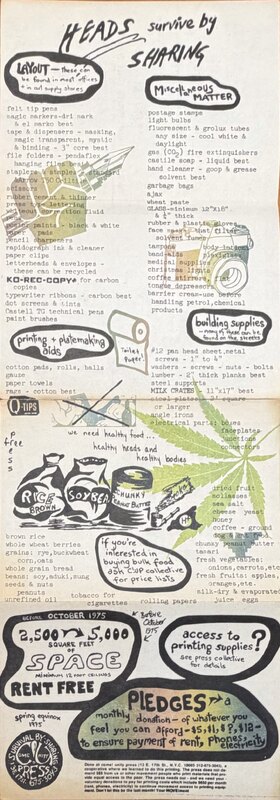
This pamphlet was produced by Come!Unity press itself to advertise the types of supplies they needed to keep the space running. It's very instructive in telling us how the printers were making their materials. First, an original is made by collaging different media including typewritten text, graphics, and photos. This is then, through a photographic process, etched onto a plate which can then be pressed onto a sheet of paper, leaving ink in the dark spots and white in the low. Quirks of this photolithographic process are responsiblefor a lot of the look you see throughout the Come!Unity materials. One of these, is that in order to print in only one color, the rollers have to be cleaned, wasting any ink that might be on them. The Come!Unity method, to economize, was to simply pprint with all sorts of bleeding multicolor backgrounds! As a result, the printers also discouraged the use of black ink, which couldn't be mixed. There was also a genuine preference for color among the printers, who furthermore suggested the use of black ink "increase[d] the use of poisonous chemicals."